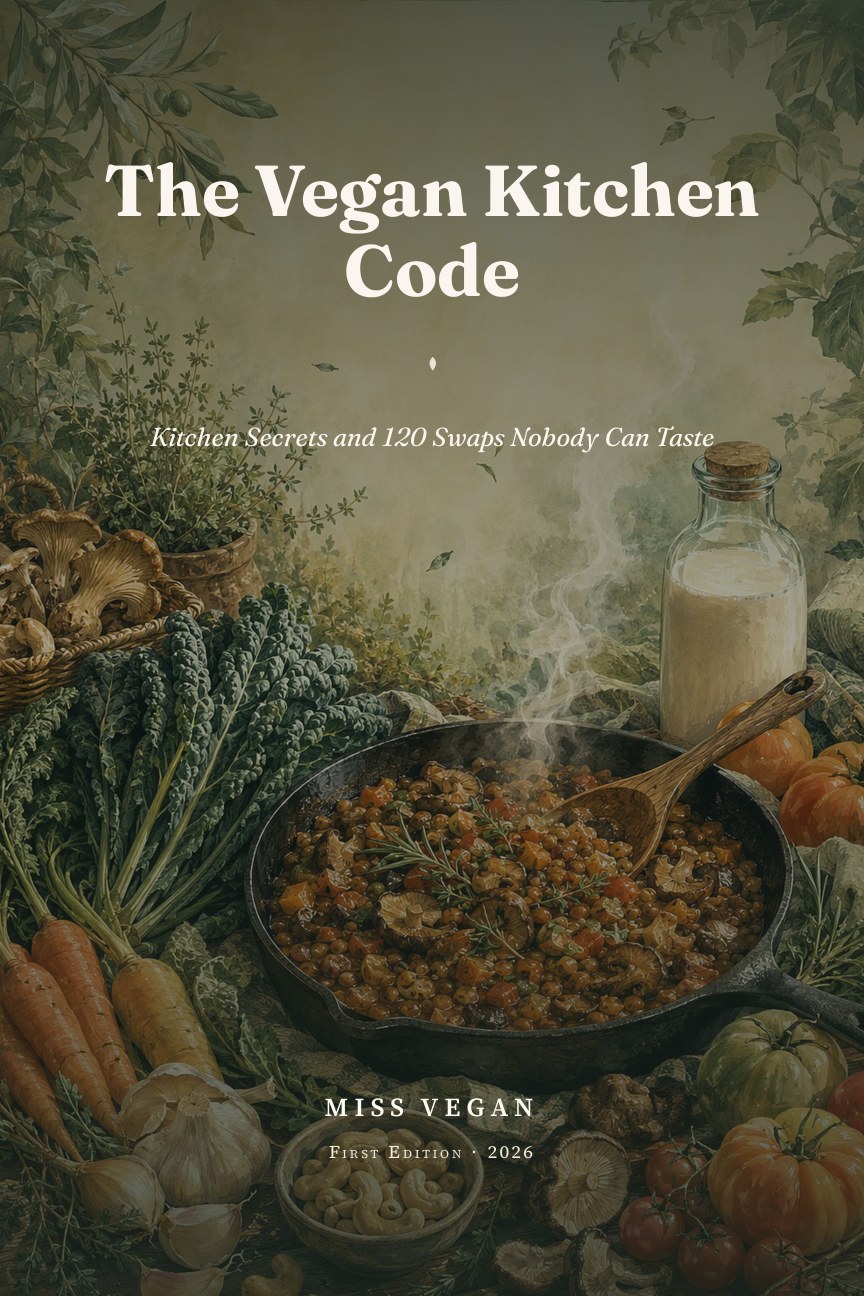
One hundred and twenty numbered swaps for the butter, eggs, cheese and meat you took out — each one with the ratio that makes it work, what it costs against the store version, and a Tell Score saying how likely anyone is to notice. Nothing above a 3 is in the book.

“Butter was not supplying butter flavor. It was supplying fat, salt, and a browning reaction.”
I assume you already made whatever decision you made, for whatever reason you made it, and that what you actually want now is for the food to be good.
I spent the first two years of this cooking badly. I made the gray lentil patties. I bought the shrink-wrapped cheese that would not melt and cost nine dollars. I made a lasagna that my brother-in-law described, generously, as interesting.
Everything I made announced itself. You could taste the absence of the thing I had removed, and no amount of enthusiasm on my part covered it up.
What changed was not a recipe. It was working out what the removed ingredient had actually been doing in the pan. An egg in a muffin was not supplying egg; it was supplying moisture and a binder. Beef in a chili was not supplying beef; it was supplying chew, fat, and a deep savory note.
“Once you know which job the ingredient held, you can hire something else to do that job, and nobody at the table notices the difference.”
That is what this book is. One hundred and twenty replacements, worked out over years of cooking, written down with the ratio, the method, the cost, and the honest odds that somebody catches you.
There are exactly five jobs an ingredient can be doing — fat, salt, umami, texture, browning. Every failure in this kind of cooking is one of them going unfilled. Chapter 1 teaches you to name which one, so you spend the rest of your life diagnosing your own dinner instead of guessing at it.
The part of the book I am most attached to. A number from one to five saying how likely it is that somebody eating your food notices anything is different.
Nothing rated above a 3 is in this book. If a swap could not clear that bar, I left it out, and the chapter says so where the omission is conspicuous.

The expensive version of this way of eating is the one where you buy replacements. The cheap version is the one where you cook. This book is entirely about the second one.
Grouped by what you are trying to replace, so you can go straight to the thing giving you trouble this week. Each chapter is short on purpose — read one with a cup of coffee and try it that evening.
“I made the Sunday base pot and used it four nights running. My husband ate the chili twice and asked me where I'd bought the sauce. He still doesn't know. That's Swap 041 and it cost me about six dollars.”
“Chapter 1 was the part I needed. I'd been cooking this way for a year and everything tasted flat and I could not work out why. It was fat, every single time. Fixed in one evening.”
“The oat milk takes ninety seconds and I have not bought a carton since. I worked out what we'd been spending on those and honestly the book paid for itself in about ten days.”

I am not a chef. I have no restaurant behind me and no formal training, and I think that is the reason this book is useful rather than the reason it isn't.
What I have is a home kitchen, a family who were not asked whether they wanted to eat this way, and years of cooking for people who would absolutely have said something if the food had been bad. That is a harder test than a cooking school, and it is the one every method in this book had to pass.
The channel came out of the same thing. People kept asking the same questions underneath all the different questions — why is mine flat, why won't it melt, why does it fall apart, why does it cost more than it used to. Those are four symptoms of five causes, and once I could see that, the book more or less wrote itself.
Where a method costs money, I say what it costs. Where it saves money, I say how much. Where it needs a piece of equipment you may not own, I say so before you are halfway in and committed. And where a swap can be caught by somebody paying attention, I tell you that too, because you deserve to know before you serve it.
Kitchen secrets and 120 swaps nobody can taste.
No. It is a technical manual about cooking, and there is not one paragraph in it trying to talk you into anything. I assume you already made whatever decision you made, for whatever reason you made it. What is left is the cooking, and the cooking is what I am good at.
The videos give you one swap at a time, in whatever order I happened to film them. The book is the system underneath them: the five rules first, then all one hundred and twenty swaps numbered and cross-referenced, so when Swap 044 needs Swap 019 you can actually go and look it up.
It also has the parts that do not film well — the ratio card, the ledger of what each swap costs, the twelve failures and their causes, and a Tell Score on every single method. And it works on the counter with no signal and no algorithm deciding what you see next.
Because a PDF costs me nothing to send, and I would rather it were in a thousand kitchens at $27 than a hundred at $200. The honest answer is also in Chapter 18: the eight money swaps come to about thirty-one dollars a week for a four-person household, so the book is meant to pay for itself in the first week and then keep going.
That is exactly what the Tell Score is for. Every swap carries a number from one to five for how likely somebody is to notice anything is different. A 1 is undetectable — I have served those to people who eat meat every day of their lives and nobody has ever remarked on it. A 3 means a careful eater paying attention might catch something, though usually not what.
Nothing rated above a 3 is in the book. Where a swap could not clear that bar I left it out, and the chapter says so where the omission is conspicuous.

Then Chapter 20 is written for you, and so is most of the rest. Nothing here asks you to change what you eat — it tells you what the removed ingredient was doing and what else can do that job, which is useful whether you are cooking one plate this way or all of them.
A PDF, delivered the moment you buy it. It reads on a phone, a tablet or a computer, and it is laid out so you can print a copy for your own kitchen if you would rather have paper next to the stove. Yours forever — no subscription, nothing to renew.
Some of it involves fermentation, home-cultured dairy substitutes, hot oil and the storage of cooked food, and those chapters carry boxed cautions. I only put a box around genuine hazards, so that when you see one you read it. Follow the hygiene steps exactly as written, and when a jar or a batch looks or smells wrong, discard it. No recipe is worth a risk.
On nutrition, Chapter 21 states the position plainly and without drama. It is a cooking manual, not medical or dietary advice.
One hundred and twenty swaps, twenty-one chapters, and a Tell Score on every method — for $27 instead of $47. Chapter 18 alone is about thirty-one dollars a week.
GET THE VEGAN KITCHEN CODE — $47 $27